

Short answer
A Telegram Mini App is a full-fledged app that opens right inside Telegram: no App Store, no installation and no sign-up. In 2023 this was called Telegram Web Apps and looked like an experiment. In 2026 Mini Apps run full-screen, can be pinned to the phone's home screen, accept payments and subscriptions, and hundreds of millions of people use them every month.
A Mini App is a good choice when:
- your audience is already in Telegram: you have a channel, a group or a bot;
- you need to launch in weeks, not months;
- people share the product with friends or use it together in a group;
- you want to test an idea for less than the cost of a mobile app.
A regular app is better when your customers are in the US or Western Europe, where Telegram is less popular, the product needs deep access to the phone, or you do not want to depend on another platform's rules. For a full comparison of all approaches, see our guide Web vs Native vs Cross-Platform in 2026.
What a Telegram Mini App is, in plain words
Imagine a website or an app that opens not in a browser or from the App Store, but right inside Telegram: from a button in a bot chat, from a link or from a channel post. The user is already signed in with their Telegram account, so there is no registration, no passwords and no SMS codes.
Two things are often confused, so it is worth separating them:
- A bot talks to the user in the chat: commands, buttons, messages. It is ideal for notifications, support and simple flows. How to build one is covered in our guide How to Create a Telegram Bot in 2026.
- A Mini App is a full interface inside the bot: a catalog, a cart, an account, a game, a booking calendar. Everything that is awkward to do with messages.
They usually work together: the bot sends reminders and status updates, and the Mini App opens when the user needs to choose, pay or set something up.
Technically, a Mini App is a web app built with ordinary technologies such as React or Vue. For a business this means two things: it is fast and relatively cheap to build, and one codebase works on iPhone, Android and desktop at the same time.
What Mini Apps can do in 2026
In November 2024 Telegram released Mini Apps 2.0, the biggest update in the platform's history, and new features have kept coming every few months since. Here is what matters for a business:
- Full screen. The app takes the whole screen in portrait or landscape mode and looks like a standalone app, not a window in a chat.
- Home screen shortcut. Users can add your Mini App to their phone's home screen and open it with one tap, almost like a regular app.
- Location and motion sensors. For delivery, taxis, finding places nearby and games.
- Storage on the device. Since 2025 there is persistent local storage and a separate secure storage for sensitive data.
- Payments and subscriptions. Built-in payments for physical goods and Telegram Stars for digital ones (more on this below).
- Sharing. Users can share content from a Mini App to chats and stories, and the app can work in groups for shared orders or multiplayer games.
- Emoji statuses and gifts. An app can show in the user's profile that they are playing a game or riding in a taxi, and reward achievements with gifts.
In practice, the difference between a Mini App and a regular app has become minimal for the user, while the main advantage for the business remains: you do not have to persuade people to download yet another app.
How Mini Apps make money
Telegram has two different rules for payments, and you need to know them before development starts.
Physical goods and offline services (food, clothing, tickets, appointments) are paid for with regular cards through the payment providers Telegram works with. There is no App Store or Google Play commission here.
Digital goods and services (subscriptions, courses, in-game items, access to AI tools, credits and tokens) can only be sold for Telegram Stars. Telegram explains this requirement by Apple's and Google's rules, and in November 2026 the platform reminded developers about it once again. If your business sells a digital product, plan the unit economics with Stars in mind from the start.
Business models that actually work in 2026:
- Selling goods and services: a catalog, a cart and checkout without leaving the chat.
- Subscriptions in Stars: several tiers of access to content or features.
- One-off digital purchases: courses, templates, premium features, in-game items.
- Advertising: developers can earn a share of revenue from Telegram Ads shown in their bots and Mini Apps.
- A Mini App as a lead source: it does not earn by itself but turns channel subscribers into customers through a calculator, a booking form, a questionnaire or a loyalty program.
An honest warning: in 2024 the Mini App audience was inflated by tap-to-earn games, and when that trend faded the numbers dropped sharply. What remained were products with real value. Build your business model on what users are willing to pay you for, not on hype.
Mini App or regular app: an honest comparison
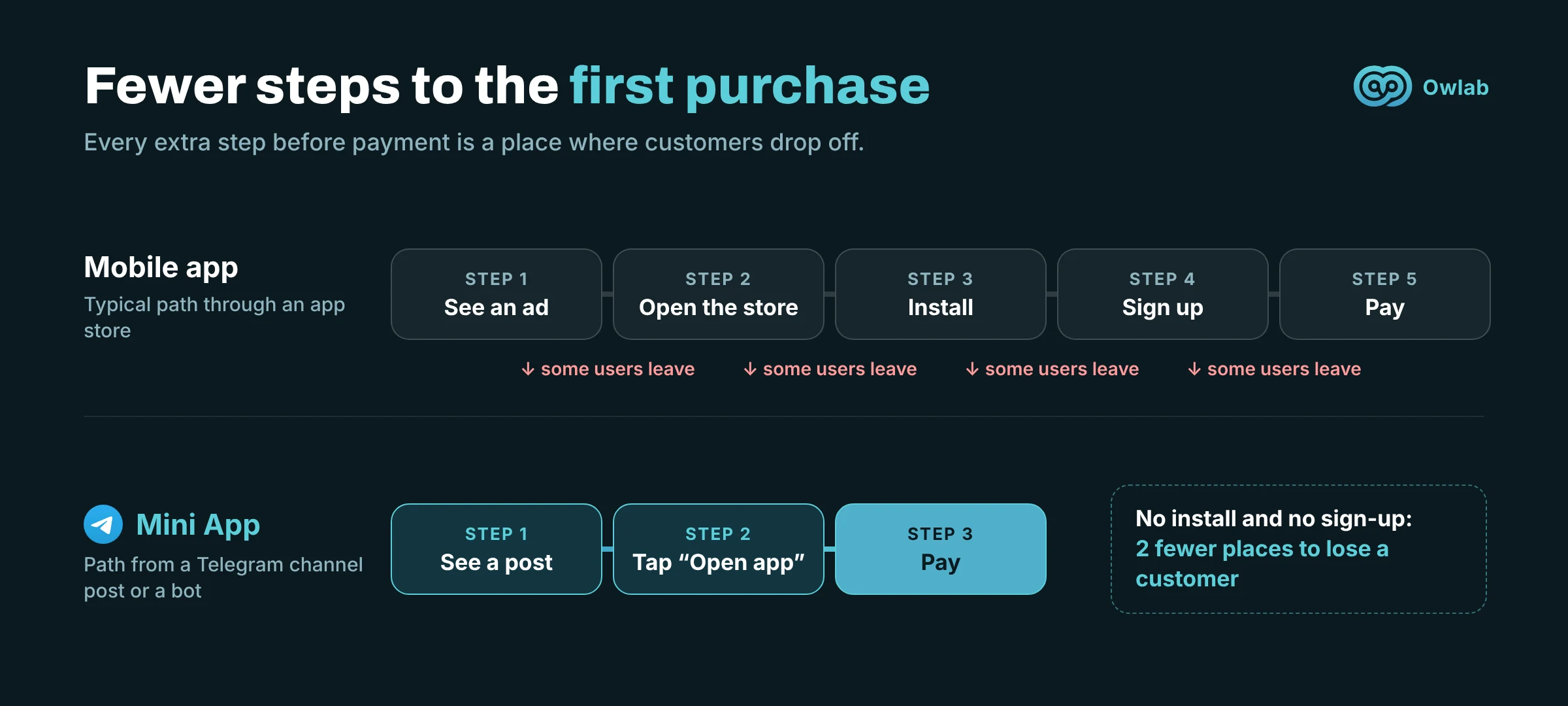
Where a Mini App wins:
- No installation barrier. One tap on a link and the person is already inside. A regular app loses part of its audience at the "download our app" step.
- No sign-up. The user is already authorized through Telegram.
- Built-in virality. Sharing in a chat or a group is easier than sharing an App Store link.
- Speed and budget. One web codebase for all devices, no store review, updates reach everyone instantly.
- A built-in communication channel. The bot sends reminders and order updates, and people read them far more often than emails.
Where a regular app is stronger:
- An audience outside Telegram. In the US and Western Europe many people do not use it.
- Deep work with the phone. Bluetooth, NFC, background work, widgets, heavy graphics.
- Control over the platform. Telegram's rules can change, and you have no say in that.
- Brand and trust. For a bank or a healthcare service, having its own app in the store often matters in itself.
In practice, it is often not either-or. A Mini App can be the first step to test an idea, or an extra channel next to your website and app. If the backend is designed well, all three work with the same data.
Already have a Telegram channel or community?
We will help you turn subscribers into customers: suggest a Mini App scenario for your business and estimate the launch timeline.
Which businesses it works for
- E-commerce and brands with a channel. A catalog and a cart right where customers read your posts. Fewer steps from interest to purchase.
- Games. Telegram has become a full-fledged gaming platform: full-screen mode, in-game purchases in Stars, leaderboards and inviting friends from chats.
- Restaurants, delivery, coffee shops. Ordering, payment and rewards without a separate app that customers delete after the first order.
- Booking-based services. Salons, clinics, gyms, consultants: a calendar, payment and reminders from the bot.
- Education and content. Courses, quizzes and paid materials on a subscription.
- Loyalty programs and promos. Giveaways, bonus cards and quests, launched in a few weeks for a specific campaign.
- Communities and social products. Events, dating, interest clubs.
- Internal tools. For couriers, sales staff and warehouses: employees are already in Telegram, so there is no new app to learn.
Owlab case: Cherry Date
The task. The client wanted to launch a social network for meeting people: finding company for a concert, the cinema, a trip or a date. For a product like this the hardest part is reaching a critical mass of users quickly, and two native apps plus store user acquisition make that much harder.
The solution. We built Cherry Date as a Mini App inside Telegram: profiles, search by interests, real-time chats over WebSockets and a clean interface that feels like part of Telegram.
The result for the business. One product instead of three (iOS, Android and web). It runs on every device with Telegram, users join without signing up and invite friends with a single link. For a social product this is what matters most: it lives where people already talk.
Risks you should know about in advance
Platform dependence. You are building on someone else's land. Telegram can change its payment or moderation rules, as it already did when digital purchases moved to Stars. Protection: keep your data and logic in your own backend, so you can quickly launch the same product on the web or as an app if needed.
Audience geography. Telegram is very strong in Ukraine, Eastern Europe, India and parts of Asia, but in the US or Germany your customers may simply not use it. Check this before you start.
Data security. A Mini App receives user data from Telegram, and it must always be validated on the server. Otherwise an attacker can pretend to be any user, which means access to other people's orders, bonuses or payments. This is one of the most common mistakes we find during audits.
Performance on low-end phones. A Mini App runs in Telegram's built-in browser. A heavy front end opens slowly on a budget Android phone, and people leave before they see the first screen.
Payment rules. If you accept cards for a digital product instead of Stars, the bot can be blocked. Align the payment setup with the rules at the product design stage.
Already have a bot or a Mini App that is slow, losing users, or you are not sure it is secure?
We will audit it: performance, security and payment setup, and tell you what to fix first.
How to launch a Mini App: the stages
1. One scenario, not "everything in Telegram". Pick one action the customer should take: order, book, buy access. Everything else comes after the first numbers.
2. Payment setup. Physical or digital product, cards or Stars, subscription or one-off purchase. The unit economics of the product depend on this.
3. Design for Telegram. The interface should feel native: light and dark themes, a main action button at the bottom, short screens.
4. A backend built to grow. Validation of user data, your own database, and an API you can connect to a website or a mobile app tomorrow.
5. Launch and first users. A post in your channel, a button in the bot, Telegram Ads, referral links.
6. Analytics and iterations. Where people drop off, what they buy, how many come back. These numbers decide whether to invest further, all the way up to a full app.
The first working version usually takes weeks, not months, which is exactly why a Mini App is such a good way to test ideas.
Want to test an idea without a big mobile app budget?
We will launch a Mini App in a few weeks, from the scenario to your first paying users.
FAQ
Are Telegram Web Apps and Telegram Mini Apps the same thing?
Yes. Telegram Web Apps is the old name of the same technology. Telegram now calls them Mini Apps, and since then they have gained full-screen mode, home screen shortcuts, location access and subscriptions.
How is a Mini App different from a Telegram bot?
A bot communicates through messages and buttons in a chat. A Mini App is a full interface (a catalog, a cart, an account, a game) that opens from the bot. They usually work together.
Can a Mini App accept card payments?
For physical goods and offline services, yes, through the payment providers Telegram supports. Digital goods and subscriptions can only be sold for Telegram Stars.
How long does it take to build a Mini App?
A first working version with one main scenario usually takes a few weeks. More complex products with payments, chats or CRM integrations take longer, but usually less time than a mobile app for two platforms.
Is a Mini App a good fit for the US and Western Europe?
As an extra channel, yes. As the only one, only if your audience is already active in Telegram, for example crypto, gaming or tech communities. For a broad audience in these markets, a website or a mobile app is the better choice.
Can a Mini App later become a regular app?
Yes. If the data and logic live in your backend, a website or a mobile app can connect to the same API, and part of the web interface can be reused.
Telegram and GRAM are trademarks of their respective owners. Owlab is not affiliated with or endorsed by Telegram or The Open Network.


