

Short answer
Most companies have already bought AI tools. Some even built a demo that impressed the board. But there is still a long way from a demo to real returns. AI has to be built into your systems, data and processes. And it has to work reliably every single day.
This is exactly what a forward deployed engineer (FDE) does. It is an engineer who works inside your business. They learn how your processes really run and write the code that connects AI to your CRM, ERP, phone lines or databases. In 2026 it is one of the most in-demand roles in tech. OpenAI, Anthropic and Google are all hiring them, and the number of FDE job postings grew many times over in a year.
For a mid-sized business there is a catch. Hiring such an engineer is expensive and slow. But there is another way. You can get an FDE as a service, for a specific project, until your AI is running in production.
What is a forward deployed engineer
The term comes from Palantir. There, engineers were "deployed forward", which means sent straight to the client. They built solutions on the client's data and inside the client's environment. With the rise of AI agents, the role went mainstream. A model on its own gives a business nothing until it is connected to real systems and processes.
An FDE combines two things that rarely meet in one person. They are a strong production engineer. And they also understand the client's business.
How an FDE differs from other roles
- A developer writes code against a ready task. An FDE first figures out which task is actually needed, and changes it after seeing how people really work.
- A consultant gives recommendations and a slide deck. An FDE writes production code and is responsible for making it work.
- A solutions engineer or presales shows what a product can do before the sale. An FDE works after the sale and takes the solution all the way to a result.
Put simply, a developer owns the code and a consultant owns the plan. An FDE owns the outcome, which is AI that actually works in your business.
Why AI projects get stuck at the demo
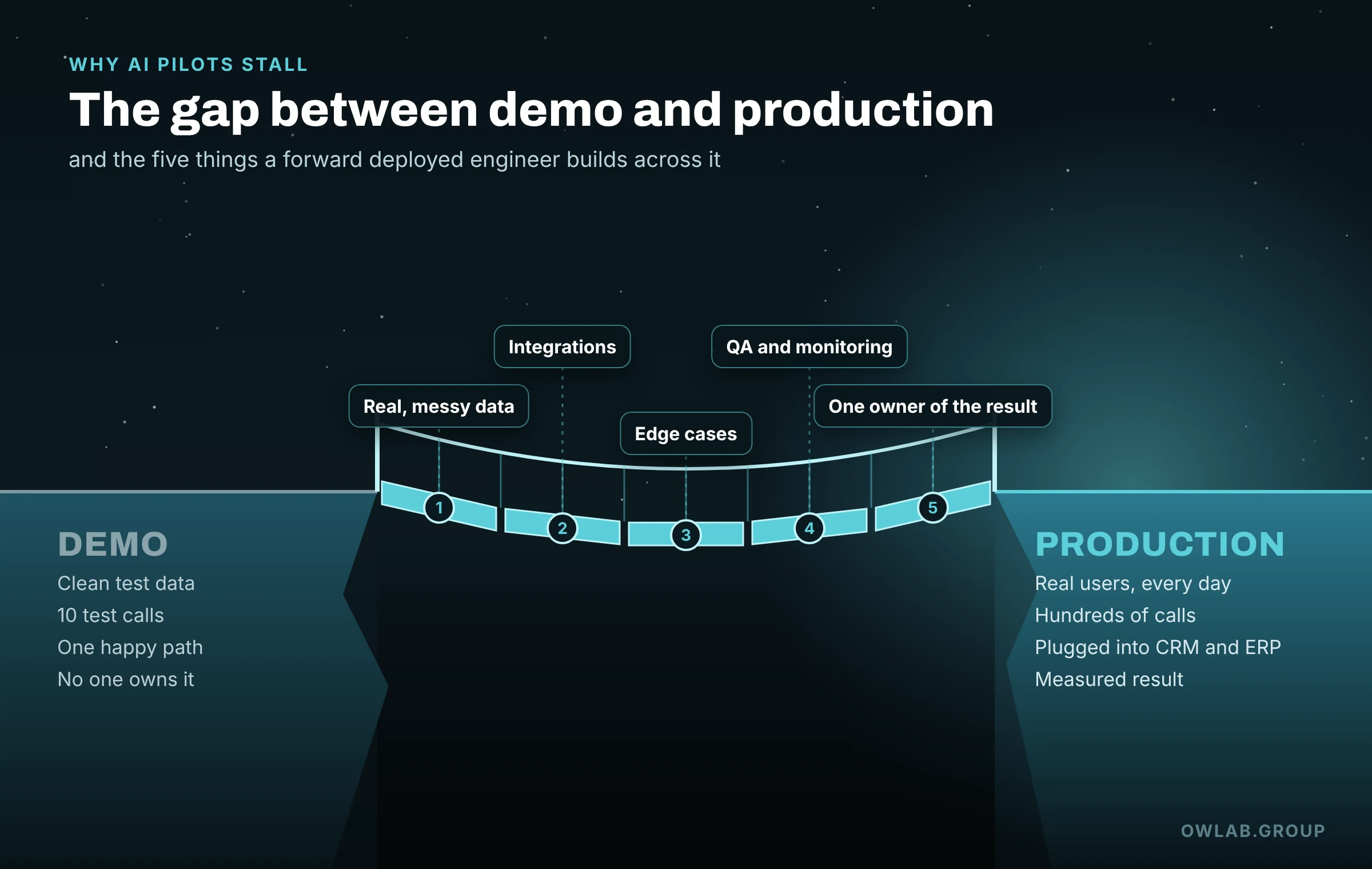
Many companies are now caught in the same trap. The AI budget is spent, the tools are bought, and there is no return. The demo works in a presentation but not on a normal working day. The reasons are almost always the same.
- The demo was built on clean data. Real data lives in three systems, with duplicates, errors and exceptions that only your staff know about.
- There are no integrations. The AI can answer questions, but it cannot create a record in your CRM, book a slot in a calendar or find a customer in your ERP.
- Nobody owns the result. The vendor sold a license, the internal team is busy with the core product, and the AI pilot belongs to no one.
- Real scenarios are harder than the demo. Customers interrupt, change their minds and call from a noisy street. What worked in 10 test calls breaks on hundreds.
- There is no quality control. Nobody sees where the AI makes mistakes until a customer complains.
None of these problems are about the model. They are about implementation. That is why big AI companies are hiring FDEs at scale. Access to a model alone does not guarantee a successful rollout.
What an FDE does in practice
An FDE does much more than "set up a chatbot". It is a full cycle from process to result.
1. Learns the process. Listens to real calls, reads the correspondence and talks to the people who do this work every day.
2. Connects AI to your systems. That means CRM, ERP, calendars, telephony, helpdesk and knowledge bases. The connections run through APIs, n8n or MCP.
3. Takes it to production. Tests it on hundreds of real situations and adds data protection, monitoring and a handoff to a human where the AI is not sure.
4. Measures the result and improves it. Not "does the bot work", but how many hours were saved, how many requests were not lost and how many reports came in complete.
What this looks like in our projects
AI agents for incident intake (USA). Security guards report incidents by phone straight from the site. Every call has to end with a complete report. The first agent pushed everyone through a long script, so details got lost and some reports arrived empty. We rebuilt the line around two AI agents. We added keypad input and a connection to the company's ERP directory. The system runs on the live line, and the client came back with new tasks.
An AI recruiter that books interviews by itself (USA). Recruiters at a security company did the same thing every day. They messaged candidates, asked screening questions and looked for a free slot in the right office. We built an agent on n8n that does all three steps over SMS and email. It works with the candidate CRM and office calendars. Now the interview simply appears in the right office's calendar.
An AI receptionist for a telecom company (Europe). The agent works on the support line of a cloud telephony provider. It knows who is calling and answers from the Help Center. During the call it works with Zendesk tickets. It never reveals account data without verification. When needed, it transfers the call to the right person.
A team of AI agents for Owlab itself. We built for ourselves what we build for clients. It is a team of AI agents on the Claude Agent SDK. They are connected to Pipedrive, Gmail, Google Calendar, Jira and Slack. The agents track, remind and draft, and a human makes the decisions.
From a homemade AI receptionist to a launch-ready platform (Australia). A founder built a voice agent for pet hotels on his own. But on test calls the agent got stuck in loops. It promised checks it never ran and said "all done" when the system failed. A classic case where the demo works and production does not. We fixed the agent and built a platform around it. We added QA, Stripe payments and a ledger that keeps track of the money.
AI signal monitoring for executive search (DACH). A recruiting firm needs to be first to know when a target company changes its CEO or owner or opens a new plant. We built a pipeline on n8n and Claude. It reads news and job postings from 1,145 companies in five countries. Out of 7,394 headlines the system kept 164 real events, each with a source and a quote.
AI alt text for 90,000 product photos (USA). An online antiques store needed to make its site accessible, and off-the-shelf tools kept crashing the site. We built a pipeline on Make inside the client's own account. AI describes each photo using the product data and writes the text straight into WordPress. The first phase went live in about two weeks.
AI accident reconstruction (USA). An injury expert's method lived in Excel macros. We moved it into a platform. Now AI reads police reports and photos, runs the expert's own formulas and prepares draft documents for the lawyer. Then we handed the project over to the client's in-house engineering team.
An AI MVP for building compliance (Australia). It took eight weeks from the first call to code handover. The app checks building products against Australian standards from a photo. It also turns defect photos into a formal report.
An AI LED wall for Archive in three weeks (USA). For a booth at The Lead Summit we connected to the client's platform data. AI watched fresh TikToks and Reels about each brand in real time. And for the whole conference it wrote each brand's story on an LED wall. It took about three weeks from the first ticket to launch.
Is your AI pilot stuck at the demo stage?
Our engineer will learn your process and connect AI to your systems. Then they will take it all the way to production.
Hire an FDE or get one as a service
Hiring in-house. There is a real war for FDEs right now. The median base salary in the US is over $170K a year. Finding someone often takes months, because the best candidates are snapped up by Palantir, OpenAI or Anthropic. There is another risk too. One engineer may not be able to cover everything alone, and that includes voice agents, integrations, security and QA.
Hiring makes sense if AI is the core of your product. Or if you roll it out to dozens of clients. Or if you already have a strong engineering team that this engineer will join.
FDE as a service. You get an engineer or a small team for a specific project. They take it from process discovery to working AI in production. Here is what that gives your business.
- A start on the same day, not in months. If you have provided all the access we need, we start on the task the day you reach out. No hiring, no onboarding and no risk of the person leaving in six months.
- Experience from projects already shipped. The team has already seen the typical problems of voice agents and integrations and knows how to avoid them.
- A whole team behind them. Design, backend, QA and security join in when needed.
- You pay only for the hours worked, not an annual salary. We will find a convenient format together, with no long-term commitments.
- Knowledge transfer. The code, documentation and access stay with you. Your team will be able to maintain the solution on its own.
The honest downside. An external FDE will not stay with you forever. So at the start it is worth agreeing who will support the solution after launch. It can be your team or a contractor.
When you work with Owlab, we find a convenient format of cooperation together. You pay only for the hours worked, and exactly as many as launch or support really takes.
Owlab takes care of support.
After launch we can stay with you. We monitor how the AI works and fix errors. We update integrations when your systems change, and we add new scenarios. Want to run the solution yourself? Then we will hand over the code, documentation and access to your team.
Sometimes an AI solution already exists, built by another team or by you. We are ready to take it over for support, and we have done it before. First we run an audit and tests on real scenarios. Then we fix critical issues and support the solution without rewriting it from scratch. That is what happened with the AI receptionist for pet hotels. The founder built the agent himself, and we took it to production and keep developing the platform around it.
For some projects and long-term clients we offer up to 1 year of free support after development is complete.
5 signs you need an FDE
1. Your AI pilot has been ready for months but never went live. Everyone likes the demo, but nobody is responsible for making it work every day.
2. The AI cannot see your data. It answers with generic phrases because it is not connected to your CRM, ERP, knowledge base or calendars.
3. Your staff spend more time fixing the AI than it saves. They rewrite reports, call customers back and look for lost requests.
4. Your team has no time or experience. Developers are busy with the core product, and nobody has worked with voice agents, n8n or MCP.
5. You pay for AI subscriptions but cannot name the hours or money saved. If the return has not been measured, it most likely is not there.
If two or more of these signs apply, the problem is not the AI model. The problem is that nobody has built it into your business.
Already spending on AI but not seeing results?
We will audit your AI implementation. We will show what works, what does not and what to change so it starts paying off.
How FDE by Owlab works
1. Process discovery (from a few days to 2 weeks). The engineer dives into your process. They listen to calls, look at the data and talk to the people who do the work. As a result we choose one scenario with the highest return and a metric we will use to judge success.
2. Build and integrations. We connect an AI agent or automation to your CRM, ERP, telephony, helpdesk and calendars. We work with Retell, ElevenLabs, n8n, Claude Agent SDK, OpenAI and MCP. We choose the tool for the task, not the other way around.
3. Launch on real data. First we launch on part of the flow, then on all of it. When the AI is not sure, it hands the conversation to a human. Where data or money is involved, we add checks and an action log.
4. Measurement and handover. We check the metric from step one and improve the weak spots. Then we hand over the code, documentation and access to your team. Or we stay on for support.
5. AI cost optimization. Bills for AI models, voice services and infrastructure can easily grow faster than the value they bring. So we choose a model for each task. For simple steps we use a fast and cheap one, and a stronger one only where quality depends on it. We add caching, remove unnecessary calls, compare providers and set limits. This makes costs predictable. We can do this for a solution that already runs, too.
We follow one important principle. AI prepares and handles the routine, but people make the critical decisions. That is how we built it for ourselves too.
Need an FDE without months of hiring?
Tell us where AI should help you. We will propose a launch plan with scope, timeline and a success metric.
FAQ
What is a forward deployed engineer?
It is an engineer who works inside the client's business. They write production code that connects AI to the company's systems and processes. Their goal is not a demo but a working solution with a measurable result.
How is an FDE different from an AI consultant?
A consultant gives recommendations. An FDE builds and launches the solution and is responsible for making it work in production.
How long does it take to get an AI agent into production?
It depends on how complex the integrations are. One scenario with two or three systems usually takes from a few weeks to two months, including testing on real data.
Do we need an FDE if we already bought an off-the-shelf AI tool?
Often, yes. An off-the-shelf tool covers standard scenarios. But to connect it to your data, systems and exceptions, you need exactly an FDE.
Who will support the solution after launch?
There are two options. We hand over the code, documentation and access to your team, or we stay on for support and development. We agree on this at the start. For some projects and long-term clients we offer up to 1 year of free support.
Can you take over an AI solution that someone else built?
Yes. We start with an audit and look at the code, integrations and AI behavior on real scenarios. Then we fix what is critical and take the solution on for ongoing support. Rewriting from scratch is usually not needed.
AI costs us too much. Can the costs be reduced?
Usually, yes. We look at where the money goes and choose cheaper models and providers for each task. We add caching and remove unnecessary calls. Quality does not suffer where it matters.


